| Notes
on the poem "Tae Sister Jean".
Sister Jean,
she was across the sea in the USA having been posted there as a
Salvation Army Officer. Joe was her husband and Rose and Lily their
two children. Isabel was another sister and Ethel her daughter.
Isabel's husband had died young so is not mentioned in the poem.
Early on in the century Isabel had gone to Boston to bring Jean
home but instead landed up being a Salvation Army officer and serving
in California.

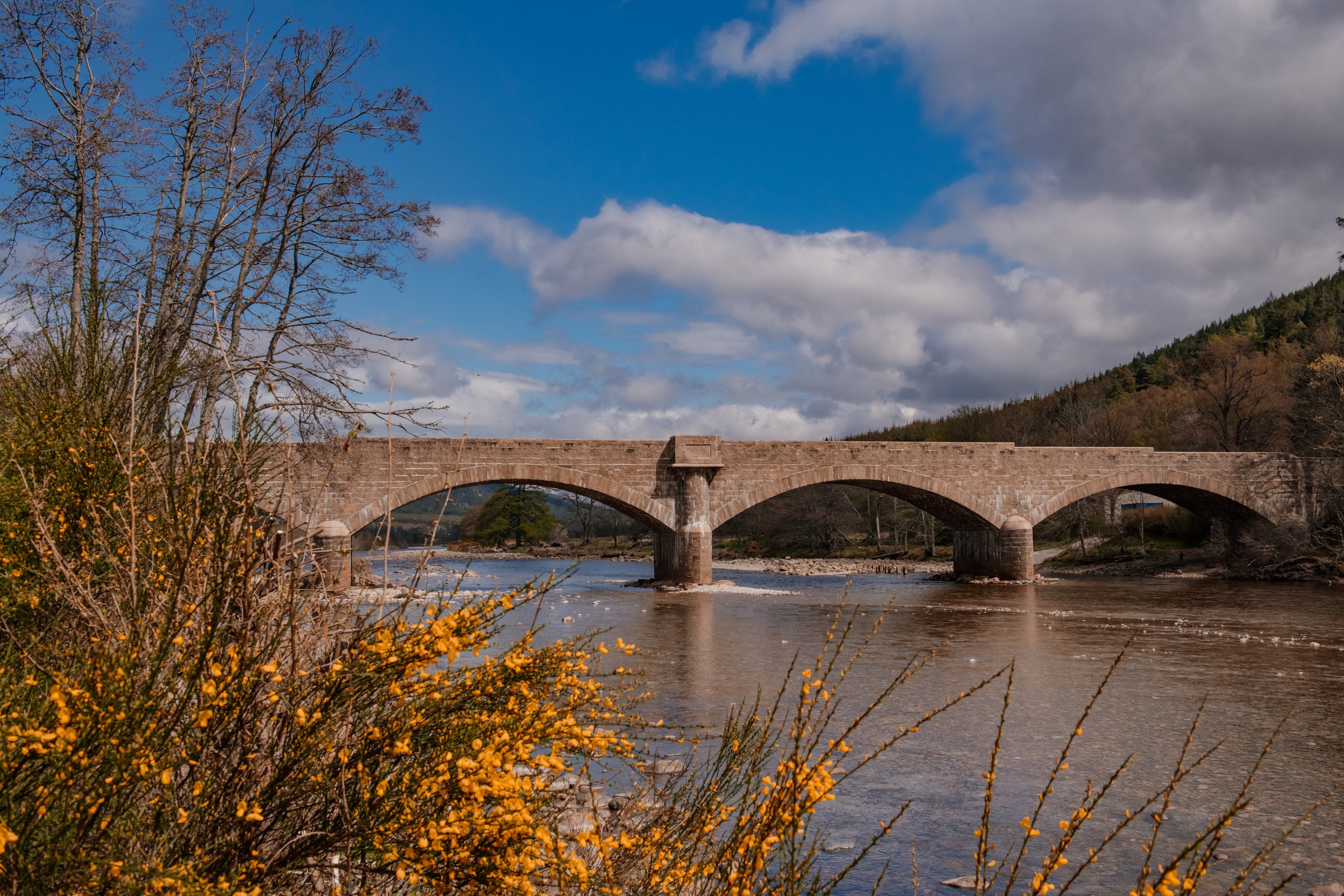
Suspension Bridge
c1900
FOOTNOTES.
1 The minister was the Rev. J.D. McKenzie, known as "Blin Bob".
He was known as Blin Bob because whenever he was talking to a "toff"
he did not recognise the ordinary member of his congregation. Died
about 1920. His wife was a Nairn, the family of which had a large
linoleum company in Kirkcaldy. She only came to Aboyne for four
weeks in a year. When her husband died, in the 1930's she built
Doraveh, over the bridge.
2 "A hoose jist owre the brig". Six sons and two sons-in-law
went to war from there. This was the house at the very end of the
bridge called Wellhouse. James and Jessie Cattanach lived there
and had a grocers shop. They had a family of seven sons and seven
daughters. The queen once stopped at the shop and bought 'pandrops'.
The family were know to royalty because Jessie looked after the
house on the edge of the Queens Loch. Two sons were killed in the
war. Henry who died on 29/10/14 aged 22 years and George who died
on 26/7/16 aged 21 years. They
served in the 2nd and 7th battalions of the Gordon Highlanders respectively
and are buried in France. In the 1920's and 30's this was the meeting
place of the boys and girls of Birse and Aboyne.
3
"Alberta" Just off Golf Road, on Formaston Park. This
was the home of the Middletons. Seven went to war and three were
killed. The boys immigrated to Canada together and came back in
Canadian regiments to fight and die in the war. Archibald Middleton,
49th Batt Canadian E.F., (Killed 10/10/1916). Charles D Middleton,
8th Batt. Canadian E.F. (Killed 14/6/1916) and John Middleton, 1st
Canadian Mounted Rifles (Killed 7/4/1917).
 |
Aboyne
War Memorial - three Middleton loons |
4
"There's fower o' oors" There were four Buchan loons that
went to war. Two were killed, Albert Buchan (Killed 23/4/1917 aged
27) and Ralph Buchan (Killed 27/6/1916 aged 20), two survived. The
two survivors were Harry, who became manager of Kennerty Milk in
Aberdeen, and Marshall.
 |
Aboyne
War Memorial - twa Buchan loons |
5
"Zepp'lins" One came across Aberdeen in 1914.
6
"Admiral Beatty" David Beatty, 1st Earl (1871-1916) British
Admiral in World War 1. He commanded a cruiser squadron 1912-1916
and bore the brunt of the Battle of Jutland 1916. In 1916 he became
commander of the Fleet and in 1918 received the surrender of the
German fleet. At the Battle of Jutland he said: "There's something
wrong with our bloody ships today". He was considered a hero
when this poem was written and was considered so into the 1920's
but by modern day standards he would only be a third rate admiral.
7
"Lion and Tiger". HMS Lion and HMS Tiger were battlecruisers,
They were big, and they were fast but were so lightly armed that
they were deemed utter failures. Our poet believed our own propaganda
when he wrote that verse. They both fought at the Battle of Dogger
Bank in January 1915 and at the Battle of Jutland, 31 May and 1
June 1916. Neither of the ships was capable of putting up a fight
against the German ships, at both of these battles both ships suffered
damage. We don't know what happened to HMS Lion but HMS Tiger was
sold for scrap in 1932.
8
"Vacant chair" This would have been son Ralph who was
killed on 27 June 1916.
9
"Lord Kitchener" Horatio Herbert, Earl of Kitchener Khartoum
(1850-1916). As War Minister during World War 1 he was a source
of inspiration to British soldiers during a successful recruitment
campaign with the slogan "Your country needs You". Kitchener
was drowned when his ship was sunk on the way to Russia.
10
"Horses" The horses from the Huntly Arms Hotel were called
to the war and sent to France. Trains from the goods yard at Aboyne
railway station transported them. The children of the village cried
as they were put on board the railway trucks. A veteran of that
war told me that he remembered seeing horses standing in mud up
to their knees, shivering with cold or fear. He said that he was
a townie but could recognise that the horses were in a bad way.
Sad that when demobilised in 1918-19 the weary and out of condition
horses simply glutted the market and went to the slaughterers in
their thousands.
11
"Blue one as well" Blue Cross, name given to a British
organisation for the care of horses and dogs in warfare, irrespective
of nationality. Run on Red Cross lines and supported by voluntary
contributions. It was founded in 1912 during the Balkan war. During
the Great War it assisted horses of the British, French and Belgian
armies and the American expeditionary force.
12
James Ramsay of Waterside died on 4 August 1932 aged 74 years. A
son, Signaller Francis John Ramsay, 7th Battalion Gordon Highlanders
died of wounds in Tourgoing Military Hospital on 15 May 1918 aged
21 years. Their other son, James Ramsay, farmed at Waterside until
he died on 18 October 1964 aged 64 years.
13
"Sandy Shaw" This was a man that was called "Bugger"
Shaw because of his habit of using this swear word. He only appeared
at Michael Fair and stayed in a shed at the mart. The village youths
threw stones at the shed, probably to rile him and get him to use
his favourite word. Our poet infers that cars were as frequent as
Sandy Shaw. (Michael Fair was at the Aboyne mart, where the supermarket
is now located, and was held over a three week period in September
every year).
14
Alexander Fowler, Roadside Cottage, Birse, died 21 September 1940
aged 74 years. Another Fowler, Andrew, was the lamplighter in Aboyne,
he lit the paraffin streetlights. He carried a small ladder and
had a duster hanging out of his pocket, which he used to clean the
globe of the lamp. One day he was up his ladder cleaning the globe
when a small boy, by the name of Rob Burnett, passed and shouted
up to him, "I can see your bits through the hole in the arse
of your breeks". Andrew was nicknamed "Leerie the Lamp
Lighter" and he lived in the first house on the right hand
side going up Balfour Road, Birsemore Cottage. This was the last
thatched house in Aboyne. It would have been slated about 1954.
15
"pick oor men" Football and cricket matches were between
the Cottagers and the Millburners. The dividing line was from the
Free Church, which is now the Masonic Hall, across to Bon a Vista.
All the boys to the west of the line were Cottagers and those to
the east were Millburners. The Cottagers were named after the Huntly
Cottages which were mini tenements. Up until the 1950's most of
the native inhabitants of Aboyne were born or had lived in the Cottages
at one time or the other, I was no exception. The Millburners came
from the east end of Aboyne and the name was associated with cottages
that were near to the where the old Mill Burn ran into the Tarland
burn.
Top of Page

Aboyne War Memorial
Alcove

Aboyne Victory
Hall built as a memorial to WWI

Aboyne Bridge
across the River Dee, c2004
|